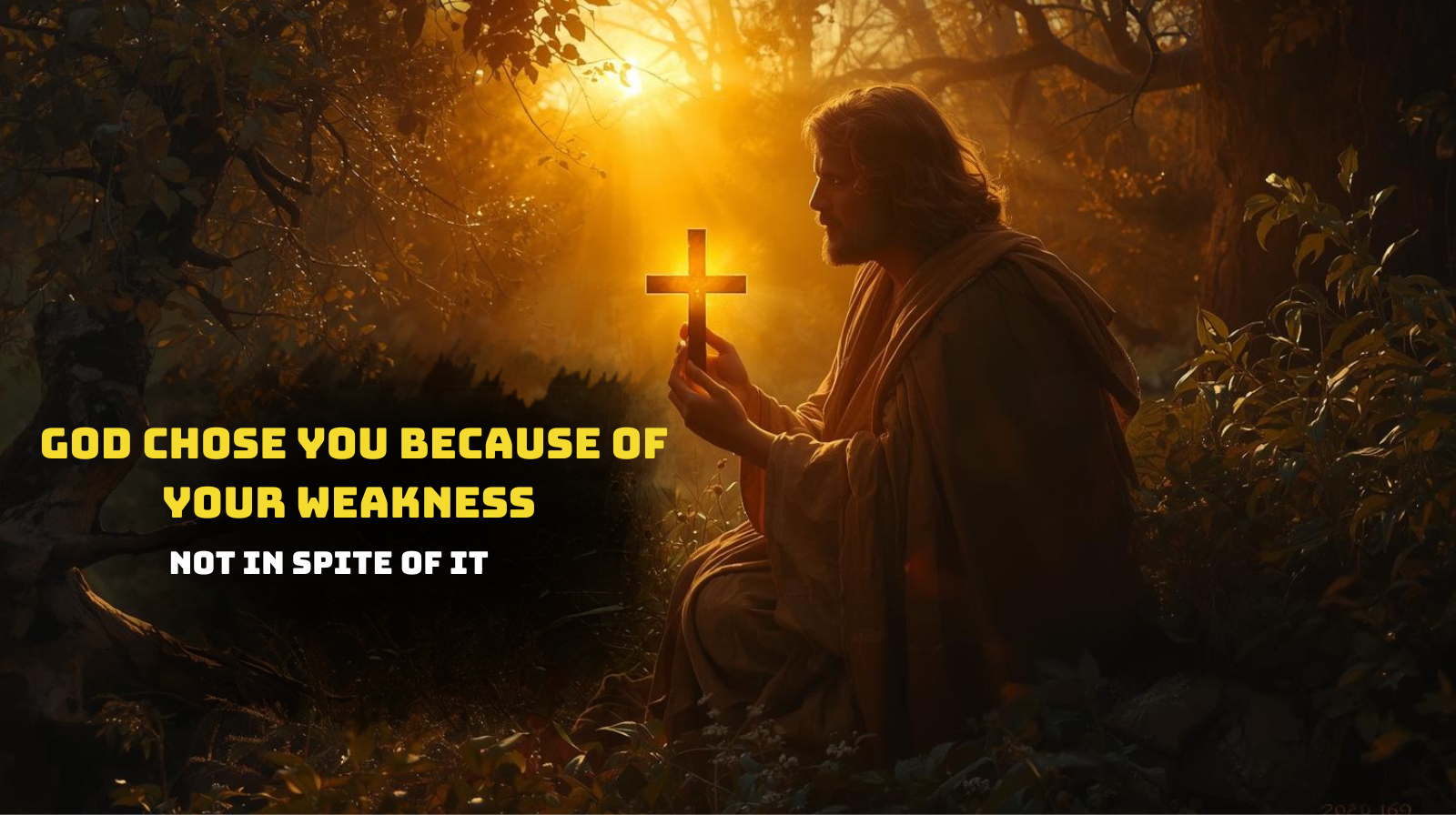
God Chose You BECAUSE of Your Weakness — Not In Spite of It
God Chose You BECAUSE of Your Weakness — Not In Spite of It
In the orchestra of life, every person is a note orchestrated by God’s divine plan. We often imagine God meticulously selecting His instruments based on their innate strength and brilliance. But what if I told you that God’s primary criterion for choosing His vessels isn’t their inherent might, but their very weaknesses? The idea that God chooses us because of our weaknesses is both radical and relieving, like a master artist choosing a cracked canvas to create His masterpiece. Is it not in our nature to shy away from our flaws, to try and present only our best selves? Yet, it is those very fractures that God uses to let His light shine through. And before we dive in, if this message is already stirring something in you, hit the subscribe button and stay connected to God's Word daily.
Biblical history is rich with characters who were anything but perfect by worldly standards. Take Moses, for example. A man with a speech impediment, chosen to speak to Pharaoh and lead an entire nation to freedom. Or Gideon, the least in his family, hiding from the Midianites, yet called a "mighty warrior" by the angel of the Lord. God seems to have a knack for picking those whom the world might sideline, saying, "You are exactly who I want." These stories resonate with us because they counteract the lie that says you must be flawless to be used by God. The reality is, He takes delight in using the unlikely and the unusual to reveal His extraordinary glory.
Often, people believe they must be strong before God could use them – but the reverse is true. As believers, we can find solace and strength in knowing that it is precisely our weaknesses that qualify us for God’s purposes. Let’s journey together through scripture and personal application to see how we are chosen not in spite of, but because of our weaknesses. Through these stories, we’ll uncover the tender love of a God who doesn’t discard the broken, but crafts them into His image, offering us hope and purpose.
Number 1: The Paradox of Power in Weakness
God’s power is often revealed most profoundly in our weakest moments. One of the clearest demonstrations of this truth is found in the writings of the Apostle Paul. In 2 Corinthians 12:9, Paul relays God's words: "My grace is sufficient for you, for my power is made perfect in weakness." Here, Paul is grappling with a "thorn in the flesh," a persistent challenge or weakness that he begged God to remove. Yet, God's response was not to eliminate the thorn but to promise His grace and strength amidst it. This easily defies our human logic that equates power with might and weakness with failure. Instead, it exposes a heavenly paradox where in our vulnerability, God becomes most evident.
When we try to mask our weaknesses, relying solely on our strengths, we inadvertently block God’s glory from shining through. Consider how a candle is most visible in darkness. Similarly, our weaknesses become the backdrop that amplifies God’s majesty. Paul embraced this truth when he declared, "Therefore I will boast all the more gladly about my weaknesses, so that Christ’s power may rest on me" (2 Corinthians 12:9b). It is not a call to boast in a self-serving manner but an invitation to live authentically, embracing our humanity, so that divine power is unmistakable in our lives.
To apply this principle to our daily lives, we need to first identify and acknowledge our weaknesses. This might be a reluctance to speak in public, struggling with self-doubt, or a particular sin we wrestle with. Whatever it might be, the first step is vulnerability before God. Acknowledging where we fall short allows God to step in and work miracles in ways we could never have imagined. It becomes less about us and more about Him. Embracing our shortcomings invites God’s strength to manifest in extraordinary ways, creating a narrative that continually points back to Him.
God’s choice to use us in our weakness isn’t merely an act of divine sympathy, but rather a deliberate strategy to demonstrate His strength. Moses, who doubted his speaking ability, was given Aaron as a spokesman, yet it was through Moses's leadership that God performed wonders. What we see here is partnership — us bringing our brokenness, and God bringing His power. The magnificent result is a testimony far beyond any human capability. Thus, lean into your weaknesses, for there God’s strength will be perfected.
Number 2: God’s Unexpected Warriors
If you need a story of divine paradox, look no further than Gideon. Found in Judges 6, Gideon’s story begins with fear and doubt. The Israelites were oppressed by the Midianites, and Gideon was threshing wheat in a winepress to keep it from them. When God calls Gideon, He calls him a "mighty warrior," an identity Gideon himself could not reconcile with his current reality. Can you imagine the disbelief? Gideon answers with doubt, pointing to his low status and the dire circumstances. Yet, God’s response is both affirming and empowering: "Go in the strength you have and save Israel out of Midian’s hand. Am I not sending you?" (Judges 6:14).
Gideon’s story is a stark reminder that God’s choice often defies human logic. From an earthly perspective, Gideon was far from a valiant hero. But God sees beyond the immediate, knowing what His power can accomplish through human frailty. Gideon questioned and doubted repeatedly, yet God patiently reassured him. Through a series of faith-building signs, God strengthened Gideon’s heart, transforming his perceived weaknesses into tools for divine victory. As Gideon gathered an army, God further trimmed it down, eliminating all but 300 men to ensure that victory would undeniably be credited to divine intervention rather than military might.
In our lives, we often see tasks or callings God places on us as daunting. Like Gideon, our initial reactions might be to highlight our inadequacies. Perhaps God’s calling you to lead in a place where you feel utterly unqualified. Yet, it’s precisely in those moments that God’s reassurance can turn doubt into faith. Scripture comme res on this in Hebrews 11:34, where it speaks of those "whose weakness was turned to strength." Every 'why me?' is transformed into 'because of Me,' where God refines and equips us not because of our capabilities but because of His sovereignty.
If this message inspires you, don't forget to subscribe for more Bible insights every week. Allow Gideon’s story to ignite your heart. Let it remind you that God looks past what appears to be and instead, focuses on what could be by His might. Every fear that whispers you can’t is met by God’s declaration that you can—because He is with you. As heirs to Gideon’s spiritual legacy, we too inherit the assurance that we aren’t defined by our limitations, but empowered by God’s limitless strength. Approach your battles with this divine perspective, and watch how God accomplishes the extraordinary through your ordinary.
Number 3: Broken Vessels, Divine Light
In the narrative of Jesus’s ministry, we see His intentional action of choosing broken vessels to carry forth His message. The disciples themselves were a motley crew of society’s broken and overlooked. Fishermen, a tax collector, a zealot—Jesus chose those who had tangibly encountered their own human frailty and societal rejection to be the pioneers of the greatest movement in history. What a testament to the idea that God desires the humble and the contrite heart, those aware of their weakness, to showcase His power.
A poignant illustration of this truth is seen in the story of Peter. Think about Peter’s journey: impulsive, often rebuked by Jesus, and disastrously denying Christ three times. Peter’s life was a collage of failures that could have easily disqualified him from leadership. Yet, after the resurrection, Jesus reinstates Peter with a profound command: "Feed My sheep" (John 21:17). Here, the man who was broken by his own fear and doubt becomes a pillar of the early church. It’s in Peter’s restored vulnerability that God’s grace abounds, turning an instrument of fear into a bold proclaimer of faith.
In everyday life, it is easy to feel disqualified from our true potentials due to our past mistakes or present insecurities. But remember, God’s light often shines brightest through cracked vessels. Your past failings don’t dictate your future use; instead, they become points of relatability where others can see God’s redemption at work. God’s kingdom thrives on individuals who recognize their need for His grace and willingly reflect that grace onto others. Much like the disciples, we are invited to offer our broken pieces to a God who composes something beautiful yet wholly His.
The story of Peter encourages us to revisit and reshape our perceptions of failure. When God sees a flawed past, He sees potential for His grace to abound. God’s work in Peter’s life stands as a testament: failure isn’t the end; it’s merely a chapter. Every desperate cry for help in our weakness becomes a canvas for God’s restorational artwork. So, let’s perceive failures not as barriers, but as entry points for grace. Embrace your imperfections, for through them, God writes His story of hope and restoration.
Number 4: The Strength in Submission
Our understanding of strength is often defined by independence and self-sufficiency. However, the kingdom of God operates on different principles. Take Jesus's life, a portrait of ultimate submission and dependence on the Father’s will. The night before His crucifixion, Jesus found Himself in deep agony in the Garden of Gethsemane. Fully aware of the suffering ahead, He prayed, "Father, if you are willing, take this cup from me; yet not my will, but yours be done" (Luke 22:42). Jesus’s submission is not a sign of weakness but the greatest display of strength.
Through submission, we witness how Jesus’s obedience allowed God’s redemptive purpose to unfold for humanity. Jesus's acceptance of His impending suffering contrasts the world’s view that equates submission with defeat. Instead, through His humble obedience, life and victory over sin were gifted to us. His story parallels ours, as we are invited to submit our weaknesses under His sovereign hand. As believers, our strength is not birthed from self-sufficiency but from our reliance upon God, understanding that our insufficiencies are sufficient in His hands.
The practical application of this truth is transformative. It challenges us to surrender control over the aspects of our lives that we hoard out of fear or pride. What if we treated our careers, relationships, or ambitions more like spaces for divine intervention? Each act of relinquishing control becomes an opportunity for God's strength to reveal itself. In moments where we lean entirely on God, choosing vulnerability over false bravado, His power transforms our smallest steps into strides of faith.
Submission, much like prayer, is a continuous dialogue with God. It is acknowledging that every limitation is an invitation for divine partnership. If this message inspires you, don't forget to subscribe for more Bible insights every week. Jesus teaches us that our weaknesses, when placed under God’s authority, become arenas for His strength. We must ask ourselves daily, "In what areas am I hesitant to submit?" and then commit to trust God with the process. In doing so, we embrace the true strength of living a life surrendered to His wondrous plans.
Number 5: Embracing Community, A Collective Strength
In our journey to understand the value of weaknesses, we must not overlook the profound strength found in community. The early church, as described in Acts 2:42-47, flourished not because of individual prowess but through collective dependence on God and one another. They devoted themselves to teaching, fellowship, and prayer, sharing everything in common. These were ordinary people with their own sets of weaknesses, yet unified, they became a powerhouse that carried the message of the Gospel to the ends of the earth.
In a society that often idolizes self-reliance, these early believers demonstrate the importance of leaning on each other’s strengths and supporting one another’s weaknesses. The church is depicted as a body with many parts in 1 Corinthians 12:12-27. Each part, with its own function, is critical to the whole. When one part suffers, every part suffers with it. When one part is honored, every part rejoices. This image beautifully illustrates how our interconnectedness in Christ brings balance and health, compensating for the individual weaknesses each person carries.
Living out this collective strength means actively seeking and cultivating authentic relationships within our communities. It means being vulnerable with our struggles and allowing others to come alongside us. Practical steps include becoming engaged in small groups, finding prayer partners, or simply reaching out for coffee chats to discuss life challenges. Embrace the notion that asking for help is not a sign of weakness but a testament to the wisdom of community living.
As we embrace our roles within God’s family, our weaknesses turn into collective strengths. We create a safe haven for grace to flourish where struggles aren’t hidden but shared, burdens are lightened, and victories celebrated together. Through community, we find belonging, and in belonging, we find strength. By faithfully engaging in fellowship, we mirror the early church, allowing our communal victories over weaknesses to shine forth as a testament to God’s binding love.
Number 6: The Unseen Intercessors
Behind the frontlines of epic biblical narratives lie the unseen intercessors—characters whose quiet strength and fervent prayers changed the course of history. A compelling example is Hannah, a woman of agonizing barrenness, who transformed her weakness into fervent prayer. Her heartfelt plea to the Lord for a son was marked with such intensity that Eli the priest mistook it for drunkenness. Yet, in her private moment of despair, she made a vow to God, demonstrating faith amid sorrow.
Hannah’s story, found in 1 Samuel 1, blesses us with two profound lessons: the power of prayer and the strength to influence the greater narrative. God honored her earnest petition, giving her Samuel, who would grow into one of Israel’s greatest prophets. Hannah’s seemingly silent contribution shows that while she lacked influence in her time, her faithful prayer life carved the path for monumental change. Through her story, we learn that our ungiven passions and private prayers can hold transformative power beyond our immediate understanding.
Modern-day application requires recognizing the power of intercession in our personal lives. Whether it’s praying for our children, communities, or nations, we operate from a position of active faith, where our perceived weaknesses are fuel for divine intervention. We reach out to God not from a stance of helplessness, but with the earnest expectation that He hears and acts upon our cries. Encourage yourself to establish a consistent prayer habit, knowing every whispered prayer has the potential for great impact, just as Hannah’s did.
Like Hannah, let us not underestimate the significance of our unseen moments with God. Each prayer, lifted in quiet places, drips with Heaven’s potential to provoke eternal change. Understand that your intercession potentially shapes the future. As we align our weaknesses with Heaven’s purposes, brokering change through prayer, God does grander things than we could envision. Never underestimate the sweeping impact of a singular prayer made in honest weakness but laced with divine power.
Number 7: A Call to Authenticity
In a world that often prizes a façade of unblemished strength, the call to authenticity becomes revolutionary. Jesus, who is described as meek and humble in heart (Matthew 11:29), provides us with the ultimate example of living truthfully. His life was void of pretense, and His interactions, full of grace and truth. While others hid weaknesses, He openly embraced His own humanity, even weeping openly in sorrow (John 11:35). In His authenticity, we see God's reflection, showing that true strength lies in living openly and truthfully.
To step into this call, we must tear down carefully constructed walls and offer our true selves to God and the world. When we mirror authenticity, we inspire others to do the same, creating spaces for genuine relationships and deeper connections. The church becomes not just a house but a home where everyone is accepted, not despite their weaknesses, but because they bring richness and diversity.
This authenticity mirrors Jesus’ approach to life and ministry—a high call to embody truth in a way that transforms both personal interactions and broader societal constructs. We can start by accepting God’s love in our genuine state, reframing our perspective from seeking perfection to inviting Him into every messy corner. As we model this rawness, we embody an encouraging witness for others, proclaiming the beauty of living in God’s grace.
True authenticity enhances our witness as believers. Our vulnerabilities become testimony of God’s redemptive work, showing potential believers that God’s love is all-encompassing and completely transformative. When we live authentically, God moves powerfully through us, weaving a tapestry of His glory through our lives. Every weakness we own becomes God’s opportunity to shine brighter. Embrace authenticity and create a ripple effect of grace, hope, and true strength.
Conclusion
Throughout this journey, we’ve explored the heart of God, who masterfully chooses and uses our weaknesses for His glory. From recognizing the paradox of power manifesting in our frailty, to witnessing God’s choice of unexpected warriors like Gideon, we understand that His criteria differ vastly from human standards. God decorates His plans through the willing hearts of those aware of their limitations and eager for His intervention. Like Peter, we watch our failures evolve into platforms for grace, while embracing submission shifts our perspectives, gently affirming our reliance on God.
In community, we find strength that transcends individual capabilities, showcasing the beauty of a collective woven together by God’s sovereign hand. Our unseen intercessions, akin to Hannah, testify of prayer’s quiet power impacting eternity. Ultimately, authenticity before God and others becomes the ultimate stage where true strength is displayed, surrendering pretense for divine authenticity.
Be reminded of God’s steadfast love and unshakeable faithfulness, choosing you for His purposes, not in spite of your weaknesses, but especially because of them. Lean into those vulnerabilities, trusting God to mold them into His masterpiece. Embrace these truths, and let your life radiate His glory amidst brokenness. Before you go, make sure to subscribe, like this video, and share it with someone who needs encouragement today. And join us next time as we uncover another powerful truth from God's Word.
Community Discussion
Please sign in with Google to share your thoughts.
No comments yet. Be the first to start the conversation!