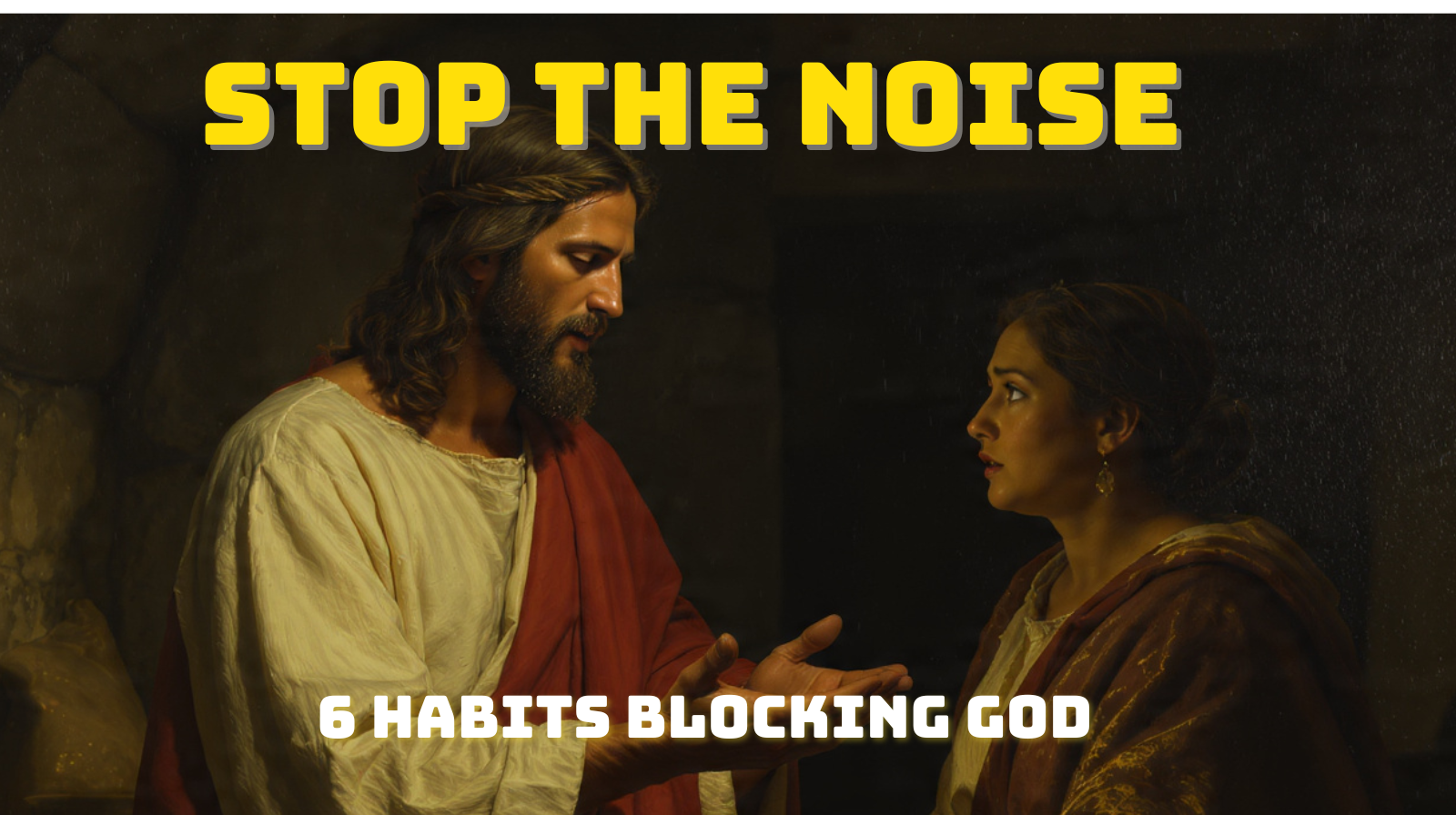
God Has Been Speaking… But These 6 Habits Are Blocking Him
God Has Been Speaking… But These 6 Habits Are Blocking Him
Have you ever felt like you are navigating life in a dense fog? You are at a crossroads—in your career, your relationships, or your spiritual walk—and you are desperate for direction. You pray, you cry out, you plead for a sign, but the heavens seem to be made of brass. The silence is deafening. You begin to wonder, "Is God angry with me? Has He forgotten me? Or maybe... He just doesn't speak to people like me anymore." We have all been there. It is that frustrating, lonely place where we feel cut off from the guidance of our Creator. But Scripture paints a radically different picture of God. It describes Him as a God who is constantly communicating. From the first chapter of Genesis where He speaks the universe into existence, to the final chapter of Revelation, God is a speaking God. Jesus said, "My sheep hear my voice, and I know them, and they follow me" John 10:27.
So, if God is speaking, and we are His sheep, why is there so often silence? The problem is rarely with the Transmitter; the problem is almost always with the receiver. Imagine trying to have a quiet conversation with a friend while standing next to a jet engine, while holding a grudge against that friend, and while checking your phone every three seconds. You wouldn't hear a word. And before we dive in, if this message is already stirring something in you, hit the subscribe button and stay connected to God's Word daily, because God wants to clear the static on the line today.
We often cultivate habits—spiritual lifestyles—that act as noise-canceling headphones to the voice of the Holy Spirit. These aren't always "big sins" like murder or theft. Often, they are subtle, daily patterns that slowly harden our spiritual hearing. We become dull of hearing not because God has stopped whispering, but because our lives have become too loud, too cluttered, or too hardened to catch the frequency of Heaven. Today, we are going to perform a spiritual diagnostic. We are going to identify the six specific habits that block God's voice, and we are going to learn how to break them. We are going to move from the frustration of silence to the clarity of communion. God is speaking. It’s time we learned how to listen.
Number 1: The Habit of Perpetual Noise The Martha Syndrome
The first and most pervasive habit that blocks God’s voice is our addiction to noise and busyness. We live in a culture that is terrified of silence. We wake up and immediately check our phones. We drive with the radio on. We work with podcasts in our ears. We fall asleep to the television. We fill every marginal moment of our lives with digital input, entertainment, and distraction. We wear our "busyness" like a badge of honor, thinking that if we are doing things *for* God, we are pleasing God. But activity is not intimacy. In fact, constant activity is often the enemy of intimacy.
We see this played out in the famous story of Mary and Martha in Luke 10. Martha was not doing anything sinful; she was serving! She was hosting the Messiah! But the Bible says she was "distracted by all the preparations." Her mind was cluttered with the noise of duty. Mary, on the other hand, sat at the Lord's feet, listening to what He said. When Martha complained, Jesus didn't validate her busyness. He said, "Martha, Martha... you are worried and upset about many things, but few things are needed—or indeed only one. Mary has chosen what is better."
God rarely shouts over the noise of your life. He does not compete with Netflix, Instagram, or your frantic schedule. In 1 Kings 19, the prophet Elijah needed to hear from God. There was a great wind, an earthquake, and a fire—loud, dramatic events. But the Lord was not in the wind, the earthquake, or the fire. Where was He? He was in "a gentle whisper" or a still, small voice. If your life is loud, you will miss the whisper. The habit of perpetual noise creates a spiritual callus over your ears. To hear God, you must ruthlessly eliminate hurry and carve out zones of silence. You must learn to be alone with your thoughts and with His Word, without the crutch of constant stimulation. Silence is not empty; it is the canvas upon which God paints His instructions.
Number 2: The Habit of Unconfessed Sin The Static on the Line
This is the blockage we least like to talk about, but it is the most critical to address. We often treat sin as a "minor issue" as long as it's not a public scandal. We harbor secret pride, hidden lust, little white lies, or "socially acceptable" greed. We think we can keep these pet sins in the corner of our lives and still have an open line of communication with a Holy God. But Scripture is devastatingly clear: Unconfessed sin is the static that scrambles the signal.
The prophet Isaiah lays it out plainly in Isaiah 59:1-2: "Surely the arm of the LORD is not too short to save, nor his ear too dull to hear. But your iniquities have separated you from your God; your sins have hidden his face from you, so that he will not hear." It’s not that God *cannot* speak; it’s that sin creates a separation. God is Light; sin is darkness. They cannot dwell in fellowship. When we cherish sin in our hearts—when we protect it, excuse it, and refuse to bring it to the light—we are essentially hanging up the phone on God.
King David knew this agony. In Psalm 32, he describes the season where he tried to hide his sin with Bathsheba. He said his bones wasted away and God's hand was heavy upon him. The voice of the Shepherd was replaced by the heavy silence of conviction. But the moment he confessed, the connection was restored. If you feel God is distant, ask the Holy Spirit to search your heart. Is there something you are holding onto that is grieving Him? Confession is the "clear history" button for the soul. It removes the static and restores the clarity of the connection. If this message inspires you, don't forget to subscribe for more Bible insights every week.
Number 3: The Habit of Selective Hearing The Jonah Complex
The third habit is subtle but deadly: we only listen to what we *want* to hear. We approach God with a pre-determined outcome. We want Him to validate our plans, bless our ambitions, and agree with our opinions. We say, "God, speak to me," but in our hearts, we mean, "God, tell me I can date this person," or "God, tell me I can take this job." When God's voice contradicts our desires, we often dismiss it as "just our own thoughts" or "the enemy," while we label our own desires as "God's leading."
This is the Jonah complex. God spoke clearly to Jonah: "Go to Nineveh." Jonah didn't like that word. It didn't fit his theology or his nationalism. So, he ran in the opposite direction. And guess what? God stopped speaking. God did not give Jonah "Plan B" or a new revelation until Jonah submitted to the *first* word. Many of us are asking God for new direction while we are still walking in disobedience to the last instruction He gave us.
God is not a consultant; He is the King. He does not offer suggestions for us to consider; He issues commands for us to obey. James 1:22 warns us, "Do not merely listen to the word, and so deceive yourselves. Do what it says." If you have a habit of debating with God, rationalizing away His conviction, or ignoring the difficult parts of Scripture, you will eventually develop a spiritual deafness. God often stops speaking when we stop obeying. If you want to hear His voice again, go back to the last thing He told you to do and *do it*. Obedience is the organ of spiritual knowledge.
Number 4: The Habit of Offense and Bitterness The Hardened Soil
There are few things that harden the heart faster than offense. When we hold onto a grudge, when we nurse a wound, when we refuse to forgive someone who has hurt us, we are building a concrete wall around our spirits. Bitterness is a loud emotion. It screams for justice. It replays the hurt over and over in our minds. It consumes our emotional bandwidth. You cannot hear the gentle voice of the Spirit when your internal world is screaming with resentment.
Jesus takes this so seriously that He connects our relationship with God directly to our relationship with others. In Mark 11:25, He says, "And when you stand praying, if you hold anything against anyone, forgive them, so that your Father in heaven may forgive you your sins." Unforgiveness blocks the flow of grace *to* us because it blocks the flow of grace *through* us. It grieves the Holy Spirit Ephesians 4:30, and when the Spirit is grieved, His voice becomes distant.
A heart filled with bitterness is like hard, dry soil. The seed of God’s Word simply bounces off. You can read your Bible, you can go to church, but the revelation cannot penetrate the layer of offense. To hear God, you must keep a "soft heart." This requires the daily, painful, supernatural work of forgiveness. It means releasing the debt, not because the other person deserves it, but because you value God's voice more than your right to be angry. A soft heart is a listening heart. If this message inspires you, don't forget to subscribe for more Bible insights every week.
Number 5: The Habit of Worry and Anxiety The Noise of Fear
Worry is a form of meditation. When you worry, you are using your imagination to construct a future where God is absent or powerless. You are meditating on the lies of the enemy. And like the habit of busyness, worry creates an internal noise that drowns out God's promises. Anxiety is like static interference; it distorts the signal. When you are panicked, every voice sounds like a threat, and it is impossible to discern the calm, reassuring voice of the Shepherd.
In the Parable of the Sower, Jesus warns that "the worries of this life and the deceitfulness of wealth choke the word, making it unfruitful" Matthew 13:22. Notice the word "choke." Anxiety strangles the voice of God. God might be speaking peace, He might be giving you a strategy, He might be offering a solution, but if your mind is spinning in a vortex of "what ifs," you cannot receive it.
The Apostle Paul gives us the antidote in Philippians 4:6-7: "Do not be anxious about anything, but in every situation, by prayer and petition, with thanksgiving, present your requests to God." The exchange is critical: We trade our anxiety for prayer. We take the energy we were using to worry and use it to talk to God. When we do this, the "peace of God, which transcends all understanding, will guard your hearts and your minds." That peace quiets the storm so you can hear the Captain. You cannot operate in fear and faith at the same time. To hear God, you must cast your cares on Him, quieting the noise of fear with the volume of His faithfulness.
Number 6: The Habit of Idolizing Logic The Sarah Laugh
We live in a rational, scientific, Western world that worships the intellect. We are trained to trust only what we can see, measure, and explain. While God gave us our minds and wants us to use them, there is a danger when we elevate our *logic* above God’s *revelation*. This is the habit of rationalizing away the supernatural. When God speaks something that doesn't make sense to our natural minds—like "give away that money" or "start that ministry with no resources"—our logic immediately kicks in to veto His voice.
We see this in Genesis 18, when the Lord told Abraham that Sarah would have a son in her old age. Sarah was listening in the tent, and she laughed to herself. Her logic said, "I am old. My husband is old. This is biologically impossible." Her logic mocked the voice of God. And the Lord asked, "Why did Sarah laugh?... Is anything too hard for the LORD?"
If you insist that God must make sense to your finite mind before you will obey, you will rarely hear Him. God’s ways are higher than our ways Isaiah 55:9. He often speaks things that contradict our spreadsheets and our five-year plans. He calls us to walk by faith, not by sight. If you have a habit of analyzing every spiritual prompting until you talk yourself out of it, you are quenching the Spirit. You are putting God in a box of your own understanding. To hear God, you must be willing to look foolish in the eyes of the world. You must trust His character more than your calculations.
Number 7: The Solution — Tuning In The Samuel Posture
We have looked at the blockers: Noise, Sin, Selective Hearing, Offense, Worry, and Human Logic. So, how do we clear the line? How do we tune in? We must adopt the posture of the young boy Samuel. In 1 Samuel 3, the word of the Lord was rare. But God called to Samuel. At first, Samuel didn't recognize the voice; he thought it was the priest Eli. Finally, Eli told him how to respond. He said, "Go and lie down, and if he calls you, say, 'Speak, LORD, for your servant is listening.'"
This is the key. It is a posture of stillness "lie down", submission "Lord", and attentive receptivity "your servant is listening". It is not "Listen, Lord, for your servant is speaking"—which is how we often pray. It is stopping the monologue and starting the dialogue. It is opening the Bible not just to read, but to hear. It is sitting in silence not to plan your day, but to sense His presence.
You can break these habits today. You can repent of the sin. You can turn off the phone. You can forgive the offender. You can cast the care. You can submit your logic to His Lordship. And when you do, you will find that God has been speaking all along. The static will clear, the fog will lift, and you will hear the voice that says, "This is the way; walk in it" Isaiah 30:21.
Conclusion
God is not silent. He is broadcasting His love, His wisdom, and His direction 24 hours a day. The question is not about His willingness to speak; it is about our willingness to listen.
We have identified the Habit of Noise that drowns Him out. We have seen how Unconfessed Sin creates static. We have exposed the Selective Hearing that ignores the hard truths. We have confronted the Habit of Offense that hardens the heart. We have recognized Worry as a distraction and Idolizing Logic as a barrier to faith.
Now, the choice is yours. Will you continue to live in the frustration of silence, or will you do the work to clear the line? Will you make space for the whisper? The Creator of the universe wants to have a conversation with you. He wants to guide you, comfort you, and reveal things to you that you do not know. Clear the clutter. Quiet your soul. And listen. He is speaking.
Before you go, make sure to subscribe, like this video, and share it with someone who needs encouragement today. And join us next time as we uncover another powerful truth from God's Word.
Community Discussion
Please sign in with Google to share your thoughts.
No comments yet. Be the first to start the conversation!