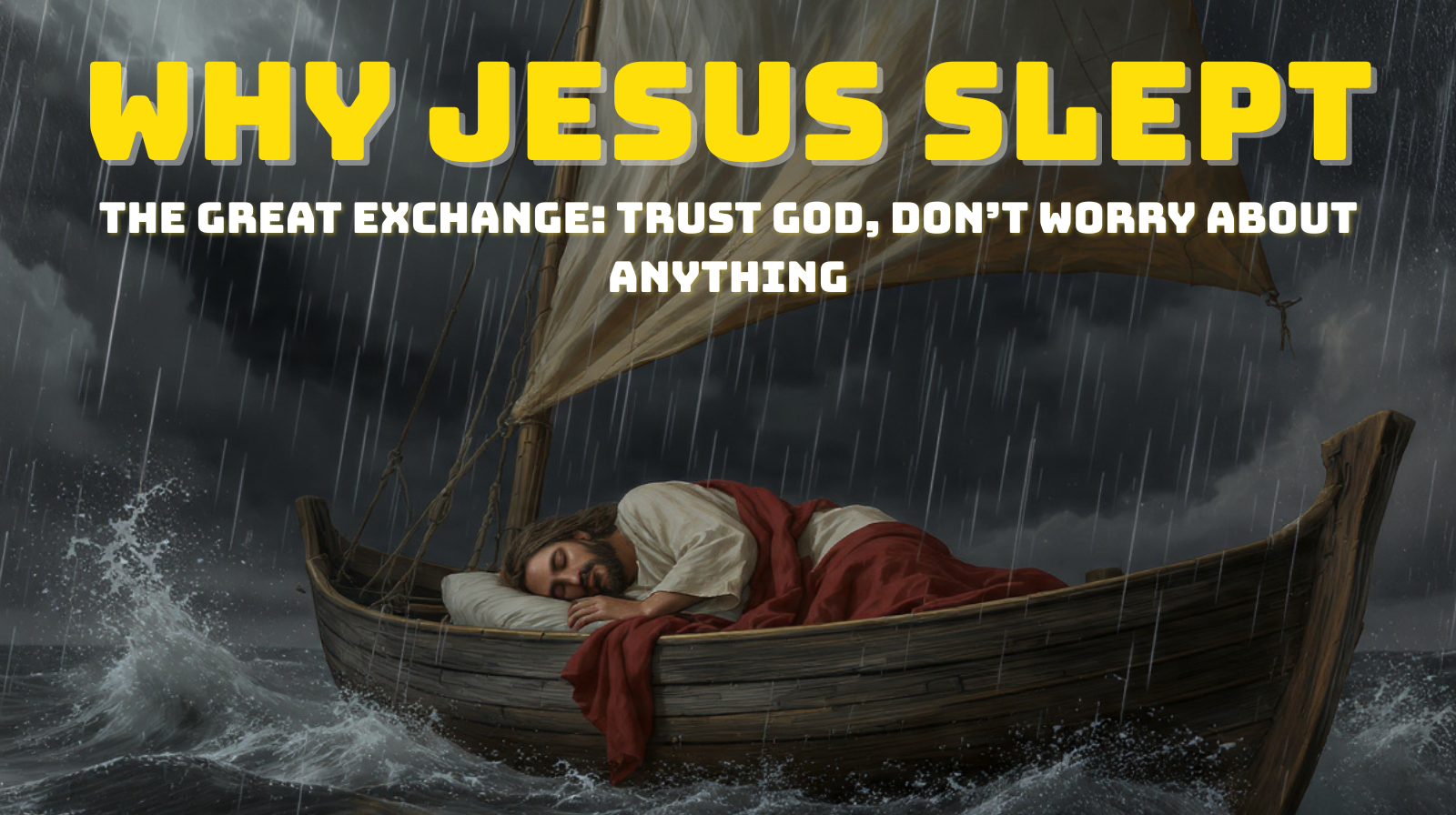
The Great Exchange: Trust God, Don’t Worry About Anything
The Great Exchange: Trust God, Don’t Worry About Anything
The word "worry" comes from an old Anglo-Saxon word, *wyrgan*, which literally means "to strangle" or "to choke." This is the perfect description of what worry does to the human spirit. It does not change the future; it chokes the present. It wraps its hands around your joy, your peace, and your strength, slowly squeezing the life out of you until you are paralyzed. We live in the Age of Anxiety. We worry about our health, our finances, our children, the economy, and the political landscape. We carry a low-grade fever of stress that never breaks. And the worst part is, many Christians have come to accept worry as a "responsible" way to live. We think, "If I don't worry, it means I don't care." We mistake panic for planning.
But the Bible issues a command that is so radical, so absolute, that it seems almost impossible to obey. The Apostle Paul, writing from a prison cell—a place where he had every logical reason to panic—writes this: "Be anxious for nothing, but in everything by prayer and supplication, with thanksgiving, let your requests be made known to God." (Philippians 4:6). Not "some things." Not "the little things." Nothing. Today, we are going to dismantle the stronghold of worry. We are going to discover that worry is actually a form of spiritual amnesia, and that trust is the currency of the Kingdom. We are going to learn how to perform the "Great Exchange"—trading our panic for His peace.
Number 1: The Absoluteness of the Command — "Nothing" Means Nothing
The first barrier we must cross is the barrier of exceptions. When we read "Be anxious for nothing," our minds immediately start writing a list of exemptions. "Sure, Paul, don't worry about what to wear... but what about my cancer diagnosis? Don't worry about the weather... but what about my bankruptcy?" We believe there is a "Threshold of Panic"—a line where the problem becomes so big that God *expects* us to worry.
But the Greek word used here allows for zero exceptions. It covers the trivial and the traumatic. Why does God command this? Is He insensitive to our pain? No. He commands it because worry is spiritually useless. Jesus asks in Matthew 6:27, "Can any one of you by worrying add a single hour to your life?" Worry is like a rocking chair. It gives you something to do, but it gets you nowhere. It burns energy, it creates heat, but it produces no motion. God commands us to stop worrying not to restrict us, but to release us. He knows that as long as your hands are full of worry, they are too full to receive His power.
Number 2: The Theology of Worry — Practical Atheism
We need to be honest about what worry actually is. It is not just a personality quirk. It is not just "being a concerned parent." At its core, worry is a theological issue. Worry is Practical Atheism. When we worry, we are acting as if God does not exist, or as if He is powerless, or as if He doesn't care. If God is All-Powerful, then no problem is too big for Him. If God is All-Loving, then He wants to help you. If God is All-Knowing, then He isn't surprised by your problem.
So, if you are worrying, which attribute of God are you doubting? Jesus connects worry to "little faith" (Matthew 6:30). He says, "The pagans run after all these things, and your heavenly Father knows that you need them." A pagan is someone who believes they are an orphan in the universe. If you are an orphan, you *should* worry, because it's all up to you. But if you are a Child of God, worry is an insult to your Father. It is saying, "Dad, I don't trust that You have this handled." To stop worrying, you don't need more money; you need a bigger view of God.
Number 3: The Mechanism of Transfer — "With Thanksgiving"
So, how do we stop? We can't just flip a switch. Nature abhors a vacuum. If you just try to "stop worrying," you will worry about the fact that you are worrying. You have to replace it. Paul gives the mechanism: "But in everything by prayer and supplication, with thanksgiving, let your requests be made known to God." Many people pray, but they still worry. Why? Because they skip the key ingredient: Thanksgiving.
They pray like this: "Oh God, please help, I'm scared, don't let this happen." That isn't prayer; that is just worrying in God's direction. True prayer is a transfer of the burden. Supplication is the request; Thanksgiving is the seal of faith. "Lord, I thank You that You are Jehovah Jireh. I thank You that You have provided before." When you thank God *before* the answer comes, you are stepping from fear into faith. Thanksgiving changes the atmosphere. You cannot worry and be grateful at the same time. The human brain cannot process those two emotions simultaneously.
Number 4: The Sentinel of Peace — The Guard at the Door
What happens when we make this exchange? Verse 7 gives the promise: "And the peace of God, which surpasses all understanding, will guard your hearts and minds through Christ Jesus." The Greek word for "guard" is a military term (*phroureō*). It refers to a sentry or a garrison of soldiers standing watch over a city gate. Paul is saying that when you trust God, He stations a supernatural Sentry at the door of your mind.
When a toxic thought tries to enter ("What if you die?"), the Peace of God says, "Halt. You cannot enter. This mind is under the protection of Heaven." This peace "surpasses understanding." That means it doesn't make logical sense. It makes sense to be peaceful at a spa. It does *not* make sense to be peaceful in a prison cell, or in a hospital waiting room. When you have peace that defies logic, you know it is not coming from your psychology; it is coming from His presence. It is a supernatural shield.
Number 5: The Lesson of the Lilies — The Argument from Lesser to Greater
In the Sermon on the Mount (Matthew 6), Jesus takes us to biology class. He points to the birds and the flowers. "Look at the birds of the air; they do not sow or reap or store away in barns, and yet your heavenly Father feeds them." Birds work (they look for worms, they build nests), but they do not *worry*. You never see a bird with a panic attack. They trust the ecosystem God created.
Then Jesus uses the "Argument from Lesser to Greater." "Are you not much more valuable than they?" If God feeds the birds (who are not created in His image, who did not cost the blood of Jesus), will He not feed YOU (who are His children)? Then He points to the lilies. Solomon in all his glory was not dressed as beautifully as a wildflower. If God lavishes such beauty on a grass that is here today and gone tomorrow, will He not clothe YOU? Creation is a constant sermon on the faithfulness of God. Every time you see a bird eat, it is a reminder: God provides.
Number 6: The "Tomorrow" Trap — Living in Day-Tight Compartments
Jesus ends His teaching on worry with a strategic command: "Therefore do not worry about tomorrow, for tomorrow will worry about itself. Each day has enough trouble of its own." (Matthew 6:34). This is the principle of Day-Tight Compartments. God gives grace in 24-hour increments. The Lord’s Prayer says, "Give us this day our *daily* bread." Not our weekly bread. Not our monthly bread.
Worry drags "Tomorrow's" problems into "Today." You are trying to solve next year's crisis with today's energy. It’s like trying to carry all your groceries for the entire year in one trip. You will break your back. God is saying, "I have given you enough grace for Tuesday. Don't use Tuesday's grace to try and solve Wednesday's problem." When you get to Wednesday, the grace will be there. Trusting God means staying in the "Now."
Number 7: Casting the Care — The Act of Release
Finally, we look at 1 Peter 5:7: "Casting all your care upon Him, for He cares for you." The word "casting" means to throw. It is a decisive action. It is like a fisherman casting a net, or a person throwing a heavy sack off their shoulders onto a truck. You cannot "carry" and "cast" at the same time. Many of us pray, "Lord, take this burden," but when we say "Amen," we pick it right back up.
To trust God, you must let go. You have to visualize yourself taking the problem—the child, the bill, the sickness—and physically handing it to Jesus. You say, "Lord, this is too heavy for me. I am not the General Manager of the Universe. I resign. You take it." Once you cast it, you don't get to worry about it anymore. It’s not yours. It’s His. If you give a package to FedEx, you don't pace the floor wondering if *you* should drive it to the destination. You trust the carrier. God is a reliable Carrier.
Conclusion
Trusting God is the hardest thing you will ever do, until it becomes the only thing you can do. It is a fight. You have to fight to rest. But remember the image of Jesus in the boat (Mark 4). A storm was raging. The disciples were panicking. But Jesus was in the back of the boat, on a cushion, asleep.
Why was He sleeping? Because He knew that the boat couldn't sink because the Word of God was on board. He had perfect trust in the Father. The disciples woke Him up and said, "Don't you care?" He calmed the storm and asked, "Why are you so afraid? Do you still have no faith?" You have a choice today. You can be the disciples—panicking and striving. Or you can be like Jesus—resting in the storm. Put down the worry. Pick up the Word. Trust Him. He has never failed yet, and He won't start with you.
Community Discussion
Please sign in with Google to share your thoughts.
No comments yet. Be the first to start the conversation!